What is 3D Reality Capture?
Aug 18, 2026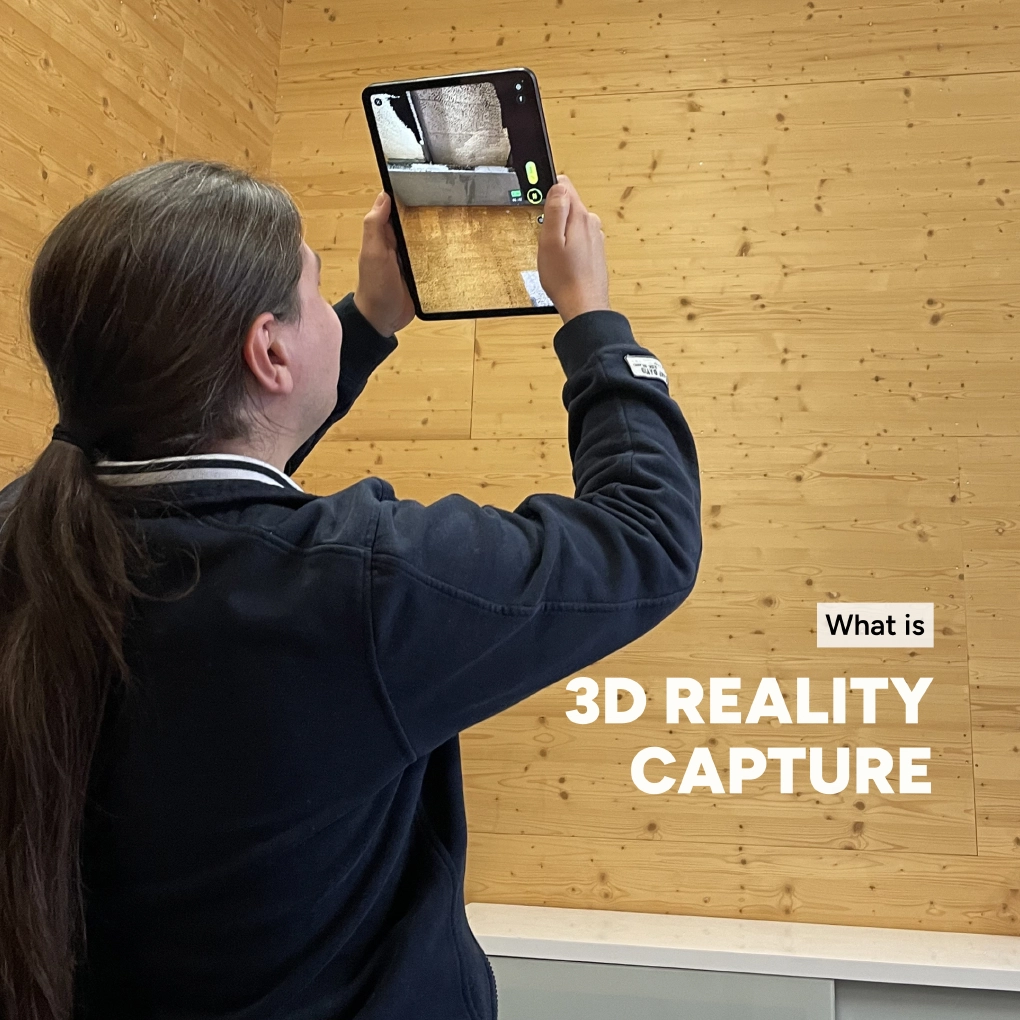
Reality capture is the process of capturing the physical world into a digital 3D model.
Different technologies can be used to do this and each has its pro’s and con’s. LiDAR, Photogrammetry and Gaussian Splatting (3DGS) capture represent the real world in different ways.
LiDAR measures
Photogrammetry reconstructs
Gaussian Splatting renders
LiDAR
LiDAR measures the physical world directly. It is a light-based depth-measuring technology that operates on the Time of Flight (ToF) principle. It captures real-world geometry by emitting laser pulses and measuring the time it takes for them to return. Each measurement point has an precise position in 3D space (x, y, and z coordinates) and is used to construct a true-to-scale 3D model of the physical space.
Photogrammetry
Photogrammetry reconstructs 3D information from photographs. By comparing overlapping images from different viewpoints, it can estimate camera positions and reconstruct the geometry and appearance of an object or environment. It can capture fine visual detail, color, and texture, but the quality of the reconstruction depends on factors such as image overlap, lighting, and camera coverage. Absolute scale also requires additional reference information.
Gaussian Splatting (3DGS)
Gaussian Splatting takes a different approach. Instead of primarily creating a measurable surface, it represents a scene using many small 3D Gaussian primitives that are optimized to reproduce its appearance from different viewpoints. The result can be very realistic and interactive, which makes Gaussian Splatting interesting for visualization and immersive experiences.
Each of these technologies is therefore
Serving a different purpose
LiDAR is optimized for geometry and speed
Photogrammetry combines geometry and visual information
Gaussian Splatting is optimized for visual appearance
In practice, they don’t have to compete. Combining technologies can bring a stronger overall result. Using LiDAR as a base provides the geometric foundation and scale, while camera data adds color, texture, visual detail, and additional information for tracking and reconstruction.
Getting started
You are looking for a true-to-scale 3D scanning solution, built for as-built documentation? Download MAVO 3D on the App Store or talk to our 3D scanning experts.
Other questions?
Talk to a 3D scanning expert.
Follow us on YouTube / @madvoxel