Is a phone LiDAR similar to a terrestrial laser scanner?
Sep 01, 2026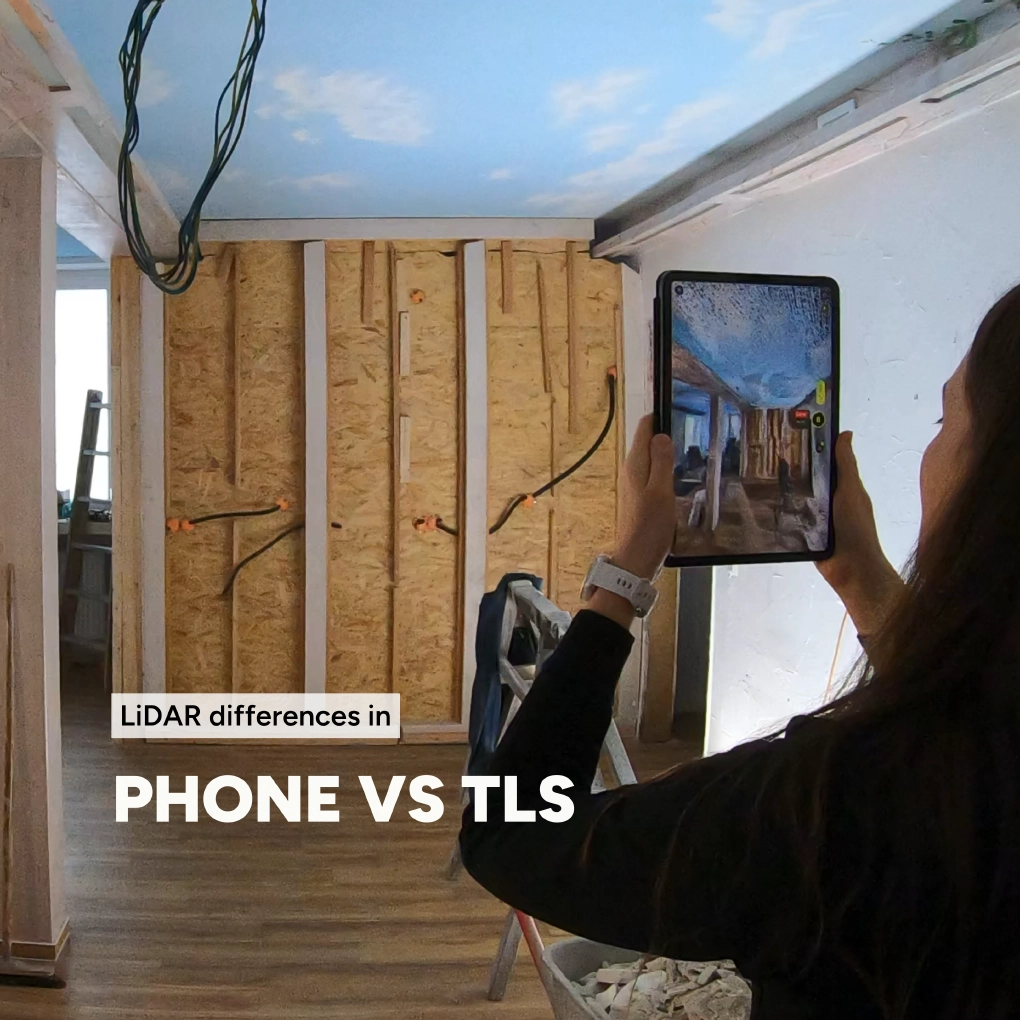
Yes and no.
iPhone Pro and iPad Pro devices have a LiDAR sensor built in, which uses the same basic principle as the LiDAR technology found in professional terrestrial laser scanners (TLS). It measures distances from the device to its surrounding elements by emitting light pulses and measuring the time it takes for them to return. However, there are significant differences in how the sensors capture their surroundings and what they are designed for.
A terrestrial laser scanner is designed specifically for 3D reality capture. Its laser is directed into the environment using a rotating mirror and scanner head, allowing it to capture a very large area from a single stationary position. Multiple scans can then be registered (stitched together) to create a complete 3D model of a building.
The LiDAR sensor in a phone works differently. Rather than capturing the environment from one fixed position, you move the device through the environment. This allows the scanning software to capture and combine measurements from multiple positions into a 3D model. The phone’s cameras and the built-in motion sensors add another important source of spatial information, necessary to make correct assumptions. They provide high-resolution visual information that helps the scanning software to understand the environment, track the device’s movement, and improve the 3D reconstruction.
A phone-based scanner therefore relies on a combination of sensors and software, rather than on LiDAR alone. The processing software is the “make or break” element here. It has to balance processing resources while simultaneously integrate LiDAR, camera and motion-sensor data and account for conditions that can change during the scan, such as lighting, movement speed and interruptions.
Range and accuracy
These differences in how the systems operate also affect their typical scanning range and accuracy.
A static TLS scan can typically achieve millimeter-level measurement accuracy under suitable conditions, while SLAM-based mobile scanning generally operates at centimeter-level accuracy.
The actual performance varies depending on the hardware, scanning environment, and importantly, the algorithms used for tracking, registration, and 3D reconstruction.
Rather than being a direct substitute for a terrestrial laser scanner, phone-based LiDAR represents a different approach to 3D reality capture. Its strength lies in combining LiDAR, cameras, and motion sensors in a compact, mobile system that makes fast scanning possible with globally available hardware and without special training.
We are working on our upcoming accuracy tests, to further explore the exact capabilities and limitations of MAVO 3D in real world use cases.
Stay tuned!
Getting started
Download MAVO 3D on the App Store and start 3D scanning for free.
Want to know more?
Talk to a 3D scanning expert.
Follow us on YouTube / @madvoxel